
Why Perfect Workout Plans Don't Work (But Flexible Ones Do)

How to stay consistent with exercise—even when life gets busy.
If you've ever started a new workout program feeling motivated, only to fall off track a few weeks later, you're not alone.
For many women over 35, it's not a lack of motivation that gets in the way. It's life.
One week you're crushing your workouts. The next week you're juggling work deadlines, family responsibilities, vacations, summer heat, or simply feeling exhausted. Before you know it, you've missed a few workouts and convince yourself you'll "start over on Monday." Sound familiar?
Here's the thing…
The most successful women aren't the ones with the perfect workout plan, they're the ones who know to stay consistent… how to adapt without giving up.
Consistency doesn't require a rigid, perfect plan. It requires flexibility.
Why Perfect Workout Plans Usually Fail
Many fitness programs are built around the idea that life should revolve around your workouts.
Workout at 6 AM every day.
Never miss a session.
Follow the plan exactly.
Eat perfectly.
While that may sound great on paper, it rarely works in real life. Life isn't predictable. Kids get sick. Work gets busy. Vacations happen. Summer schedules become chaotic. Sleep suffers. Hormones fluctuate.
When your plan doesn't allow for those realities, even one missed workout can feel like failure. That's when the all-or-nothing mindset creeps in.
Instead of adjusting, many women quit altogether.
The problem isn't your discipline.
The problem is trying to follow a plan that leaves no room for real life.
What a Flexible Fitness Routine Actually Looks Like
Let's clear up a common misconception. A flexible fitness routine does not mean doing whatever you feel like each day. It also doesn't mean skipping workouts every time life gets busy.
A flexible routine is still built on structure. The difference is that it allows you to make smart adjustments while staying committed to your long-term goals.
For example:
You planned a 60-minute strength workout but only have 30 minutes? Complete your main compound lifts and skip the accessories.
It's 95 degrees outside with high humidity? Move your workout indoors or reduce the intensity of your cardio.
You're on vacation? Explore the area on foot, go for a hike, or complete a short hotel workout instead of skipping movement altogether.
You slept poorly? Adjust your training load instead of trying to force a personal best.
Notice what's happening?
You're still showing up.
You're simply changing how you train—not whether you train.
That's what builds consistency over months and years. That’s how you create a permanent, healthy lifestyle.
Something Is Better Than Nothing…But It Should Still Move You Forward
You've heard the phrase, "Something is better than nothing”, and I fully agree… with one important caveat.
Your "something" should still have purpose.
I often encourage clients to think in terms of the Minimum Effective Dose.
Instead of asking: "Can I do my full workout today?"
Ask yourself: "What's the most effective workout I can realistically complete today?"
Sometimes that looks like:
A 20–30 minute strength session
A brisk 30-minute walk
A ruck around your neighborhood
A quick bodyweight workout
A mobility session after a stressful day

These workouts still move you toward your goals because they maintain your routine.
Remember, consistency compounds.
One shortened workout doesn't hurt your progress. Repeatedly doing nothing does.
Why Strength Training Still Needs to Be a Priority
Flexibility doesn't mean replacing every strength workout with cardio, or only getting your steps in.
Strength training becomes even more important, especially as we enter the perimenopause and post-menopause stage of life.
Building and maintaining muscle supports:
A healthy metabolism
Bone health
Balance and functional strength
Everyday independence
Healthy aging
Muscle doesn't just improve how you look. It improves how you live. That's why strength training should remain one of the cornerstones of your routine, even when life gets busy. If time is limited, prioritize your strength workouts whenever possible and adjust the volume before eliminating them completely.
Strength Training Should Feel Challenging
Another misconception I hear often is: "I don't want to lift heavy because I don't want to overdo it."
Here's the reality. For your body to build or maintain muscle, your muscles need a reason to adapt. That means your workouts should feel challenging.
Feeling your muscles fatigue or even burn during a set isn't necessarily a bad thing. In fact, it's often a sign you're working hard enough to stimulate strength and muscle growth. That doesn't mean every workout should leave you exhausted. It means your effort should match your goals.
Think of it this way:
Easy workouts have their place.
Recovery workouts have their place.
But if every strength workout feels easy, your body has little reason to change.
The goal isn't to chase soreness. It is to progressively challenge your muscles over time.
Use RPE to Train Smarter
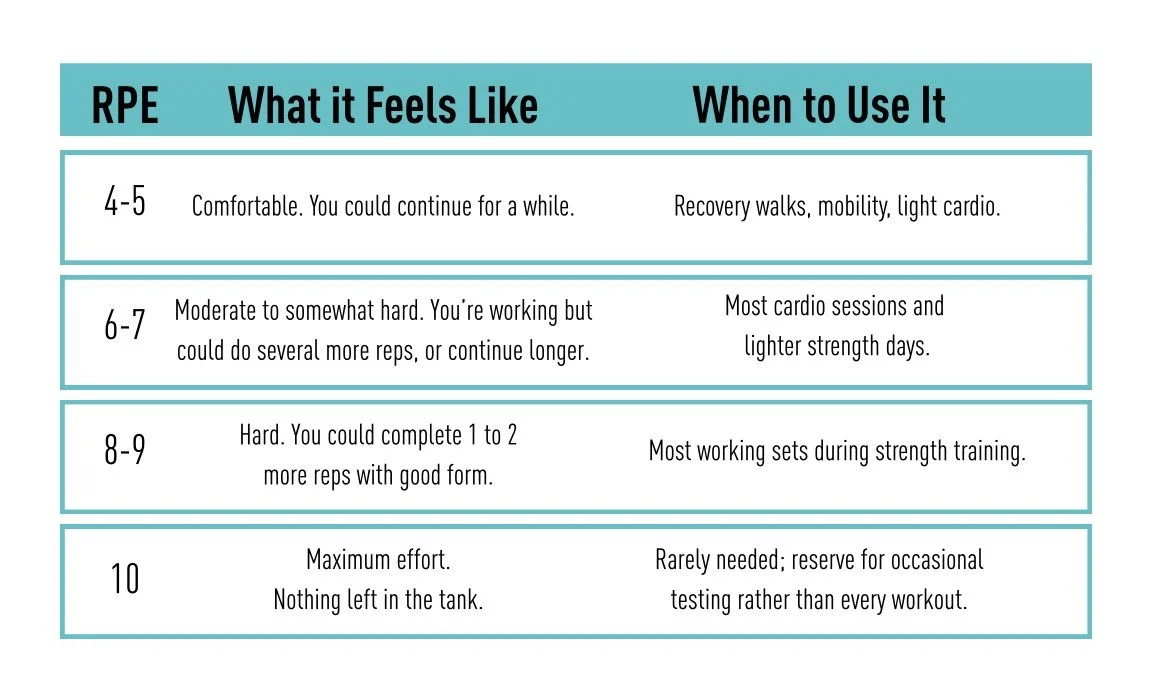
One tool that can be used to stay consistent is the Rate of Perceived Exertion (RPE) scale. Rather than training at the exact same intensity every workout, RPE helps you adjust your effort based on how your body is feeling that day.
For building and maintaining muscle, most strength-training sets should feel challenging, typically around an RPE of 8–9, this provides enough stimulus for your muscles to adapt while still allowing you to recover and continue training consistently.
Your body doesn't know you planned leg day. It only knows the total stress you're experiencing.
Sleep, work demands, nutrition, hydration, hormones, and even the summer heat can all influence how hard a workout feels. Some days, the weight that felt manageable last week may feel significantly heavier, and that’s okay.
Using RPE allows you to adjust your effort without abandoning your workout altogether. That's smart training. It helps you train consistently while respecting what your body needs on any given day.
Summer Heat Changes the Equation
During the summer months, especially if you live in a hot, humid climate, your workouts may feel harder than usual. That's completely normal.
Heat increases cardiovascular strain, raises your heart rate, and can make the same workout feel significantly more difficult.
Instead of assuming you're "out of shape," consider making small adjustments:
Exercise earlier or later in the day.
Stay hydrated before, during, and after your workout.
Slow your pace when necessary.
Move strength workouts indoors if possible.
Reduce cardio intensity during extreme heat.
Adjusting for the environment doesn't mean you're making excuses. It simply means you're training intelligently.
Signs Today's Workout Might Need to Be Modified
Not every workout needs to be identical. Some days your body is ready to push. Other days, it needs a slightly different approach.
Consider modifying your workout if:
You had a poor night's sleep.
You're feeling unusually stressed.
You're recovering from illness.
You're exercising in extreme heat or humidity.
Your energy levels are significantly lower than normal.
Modification might mean:
Reducing the weight slightly.
Performing fewer sets.
Choosing a walk instead of a run.
Shortening your workout while maintaining quality.
The key is to avoid confusing modification with quitting.
Plan Ahead So Flexibility Doesn't Become an Excuse
Here's where many people get flexibility wrong. They think flexibility means deciding each day whether they'll work out.
That's not flexibility. That's relying on motivation, which varies each day.
A flexible plan is still a plan.
At the beginning of each week:
Schedule your workouts like important appointments.
Decide which days are best for strength training.
Build in walking or outdoor movement.
Have a "Plan B" for busy days.
Maybe your ideal workout is a 60-minute gym session. Your backup plan might be a 30-minute workout at home. Or perhaps your backup is a brisk walk and a short strength circuit.
Having a backup plan makes it far more likely that you'll stay consistent instead of skipping exercise altogether.
Remember: Flexibility should change how you train - not whether you train.
Final Thoughts
If you've struggled to stay consistent with exercise, don't assume you need more motivation or a stricter plan.
More often than not, you need a plan that's realistic enough to survive real life.
Some weeks you'll have more energy. Some weeks you'll have less.
Some workouts will be longer. Some will be shorter.
What matters most is that you continue showing up.
Because the women who achieve lasting results aren't the ones who never miss a workout.
They're the ones who refuse to let one imperfect week turn into months of doing nothing.
Consistency isn't built through perfection. It's built through adaptability.
Ready to Build a Fitness Routine That Fits Your Life?
If you've spent years playing “catch-up”, starting over every time life gets busy, it may not be because you lack motivation. More often, it's because you've been following plans that leave no room for real life.
As a Functional Nutrition Coach, Women's Coaching Specialist, and Occupational Therapist, I help women 35+ build realistic nutrition and fitness routines that adapt to busy schedules, changing hormones, vacations, family obligations, and everyday life, without sacrificing progress.
Through customized coaching, you'll receive personalized strength training, nutrition guidance, accountability, and ongoing support to help you build sustainable habits that last.
If you're ready to stop chasing perfection and start building consistency, I’d love to help.
Ready to learn more. Click here to get started.